
Crusader Rex is even better than its predecessor Hammer of the Scots. It retains many elements of the earlier Jerry Taylor game but small changes to the rules as well as a different map and force pool impart a noticeably different feel. Furthermore, the luck of the cards and the draw pool has less of an impact than in HoTS and player strategies are less constrained. Playing Crusader Rex again after a break of several months, having played a number of more complex wargames in the meantime, I am struck by how a block wargame with only 8 pages of rules can be so tactically rich and provide such a convincing narrative.

This edition of Crusader Rex has honed an already good game into an excellent one. I own most of the Columbia games range and this comes to the table more than any other. It has the perfect mix of tough decisions and fun. Is much deeper that Columbia’s latest offering Julius Caesar and as a result is infinitely more rewarding. For those who have the original? The second edition is still worth the money. Better Maps, unit tweaks, card changes and streamlined rules. The second edition is head and shoulders above the original and most important of all the play balance is now spot on. Enjoy 🙂

Update 2021, still love this game. I can’t praise this game enough. 12 plays (Second Edition. Great replayability. No game has been similar to the others. Light on the rules, heavy on tough decisions and strategy. From my experience 3-5 hours depending on if either player is AP-prone. However, as play time is prolonged due to agonizing decisions, I view this as a positive aspect of the game. I can’t complain about game balance. A personal goal of mine is to conduct a successful campaign to seize Damascus, as the Latins. Negative: I had big trouble with the stickers, nearly ripped every sticker I tried to remove from the sticker sheet. Have not experienced this problem with any other CG-game so perhaps I just got the odd bad set. What a great, great game. Always willing to play. Have both editions. Only played second ED. AND this game raised such an interest in the period that I’ve read 10 books on the topic.

Great game! The only other Crusades game I can think of is “Onward, Christian Soldiers,” although I bet the rules are five or ten times longer. In my opinion, the thing that probably makes it better than “Hammer of the Scots” is that it seems that the game is always close near the end. The Franks have to be very defensive in the beginning while the Saracens have to be very aggressive. The Franks must protect one additional city at the start of the game with essentially weaker forces. In my first game, I thought I was going to win the battles I lost and lose the battles I won. I remember in that game my Saracens attacked Jerusalem with double the force and half my force was gone before I even got to roll the dice! I like the fact that Tripoli and the non-objective city of Tyre both have a special peninsula defensive property. The Saracens also generally have a better movement rate and typically attack earlier in the combat round. It seems that the game is often determined by when the Franks decide to use their knight’s charge ability. I’ve found that the knight’s charge can be rather ineffective with anything other than the B3s and Richard the Lionhearted who is a B4.

What is Richard III: The Wars of the Roses?

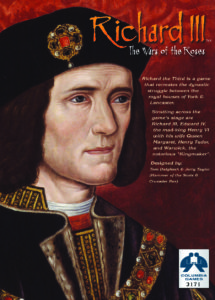
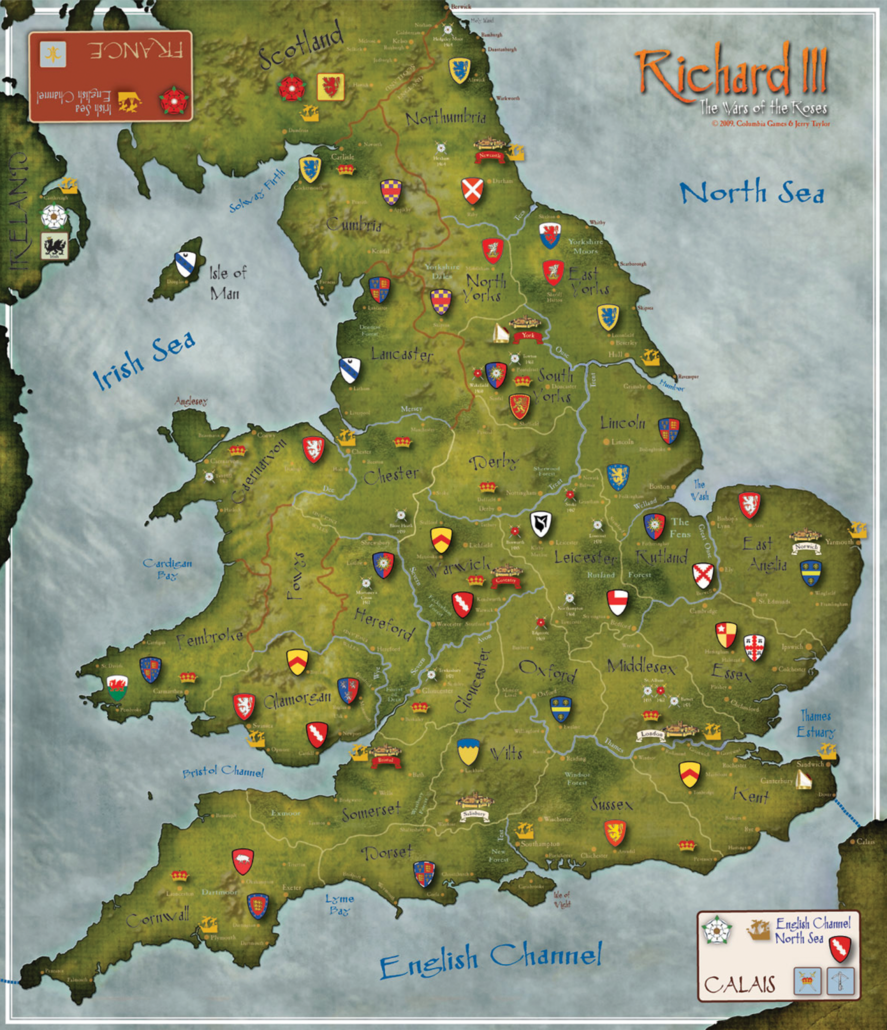
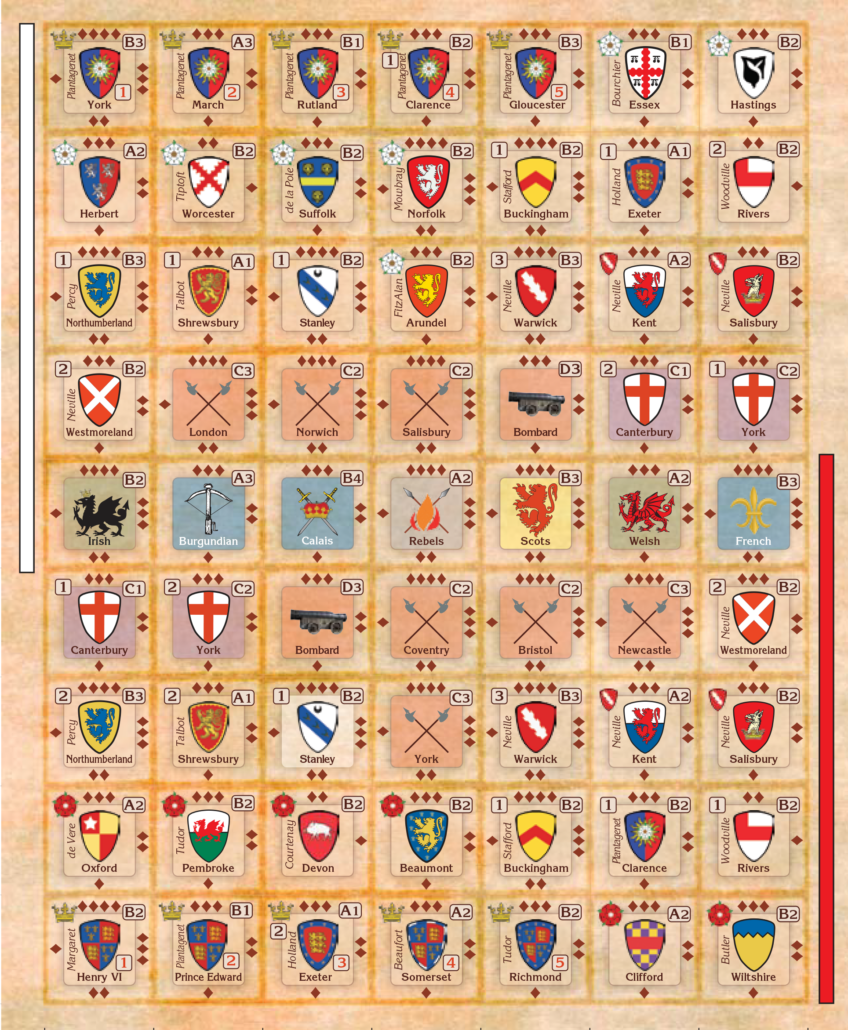
Richard III: The Wars of the Roses is an epic two-player game concerning the long and bloody dynastic struggle between the houses of Lancaster and York for the throne of England. The game depicts both the vicious military campaigns and the rich political struggles that surrounded the late rule of the mad-king Henry VI, the Yorkist usurper Edward IV, the bloody rule of Richard III, and the early years of the first Tudor king, Henry VII. Also strutting across the game’s stage and toward the throne is Richard of York, the patriarch of the house of Plantagenet; Richard Neville, the notorious “Kingmaker”; the iron-queen of Lancaster, Margaret of Anjou, and the would-be Lancastrian king Edward, the Prince of Wales.

Game at a Glance

Players: 1–7
Playing Time: 2–8 hours
Period: Napoleonic Wars, 1804–1815
Scenarios: 1804–1807, 1808–1811, 1812–1815, or link all three into a full Campaign
Complexity: Medium
Designers: Tom Dalgliesh, Grant Dalgliesh & Bruce McFarlane
System: Columbia Block System